Trust, But Verify
Why we shouldn’t fully believe what we’re seeing
Back in the late 80s, when Ronald Reagan was president and tensions with the Soviet Union were high, the two sides got together to negotiate the terms of a nuclear disarmament treaty in the hopes of stabilizing relations between the world’s two great powers. These kinds of negotiations happened often during these years. But as anyone old enough to remember the Cold War can tell us, neither side trusted the other to act in good faith. The distrust was rooted in a long history of espionage on both sides of the wall.
So when Reagan entered into disarmament negotiations in 1987, he was asked if he could trust the Soviets to do what they agree to in the talks, and Reagan responded with an old Russian proverb that translates into English as “Trust, but verify.”
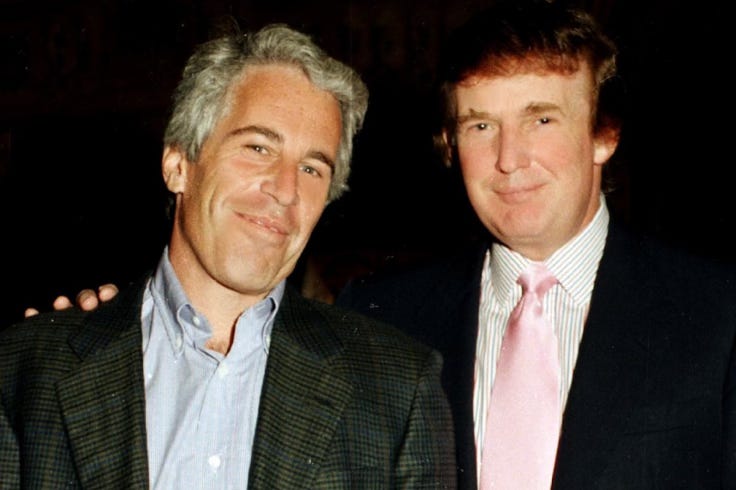
And that simple phrase has been running on a loop in my head ever since I heard that the DOJ released another batch of the Epstein Files. And as the hours pass and the salacious details included in the files are discovered and then published in one form or another, I keep hearing that warning in my head. Trust, but verify.
The first step in verifying just about any information is to scrutinize the source, and in this case, the source is our own Department of Justice. And while the DOJ’s record on truth-telling has been spotty at several akey historical moments, the institution itself has been trusted by the public for generations. However, now that Trump has captured it and placed it firmly under his boot, that trust is gone, which in turn means we can no longer expect the DOJ to tell us the truth, nor can we fully believe anything it gives us.
After all, even if we were to discover that the DOJ planted false information into the Epstein Files, the only people we could refer them to for prosecution … is themselves. We may have passed legislation to force the release of the Epstein Files, but we didn’t include a way to enforce that law, so now we’re getting exactly what we had coming, which are delays, half-measures, and quite possibly DOJ generated misinformation. I do not know this is happening, but motive and opportunity are everywhere, and it’s not like they don’t lie to us all the time these days.

The entirely unaccountable agency that told us that both Renee Good and Alex Pretti were dangerous domestic terrorists who needed to die would certainly also engage in the same kind of disinformation campaigns to protect Trump’s inner circle of rich pedophiles. And unfortunately, the rest of us are left picking up the pieces of a country in which no one really knows what’s true and what isn’t, which is exactly what the authoritarian regime wants. After all, as any disinformation expert can tell you, the best liars do not defend themselves by saying their lies are true, but instead they defend themselves by saying “everyone is lying.”
And if we fail to verify, they’ll be right.
Brett Pransky is a writer, a teacher, a father, and a husband, but rarely in that order. He spends his days amplifying the voices of freedom and democracy as an Editor right here at The Political Voices Network, and he spends his nights trying to fix the world one clever sentence at a time.


Another day, another batch of BS. Trust Trump & his administration to always deliver a load of lies and hatred.